
Choosing the correct thickness for drywall studs and tracks is an important part of designing a reliable drywall partition or wall framing system. The thickness of the galvanized steel profile affects its stiffness, strength, weight, cost and suitability for different applications.
However, choosing a drywall stud based only on the thickness in millimeters or the gauge number is not always enough. Project requirements, stud width, wall height, spacing, load requirements, steel grade and local building standards should also be considered.
This guide explains the key factors to consider when selecting the right thickness for drywall studs and tracks.
Drywall studs and tracks are cold-formed galvanized steel profiles used to create the framework for drywall partitions, ceilings and other lightweight interior construction systems.
A typical drywall partition consists of:
The stud provides the main vertical support, while the track creates the connection between the floor, ceiling and vertical studs.
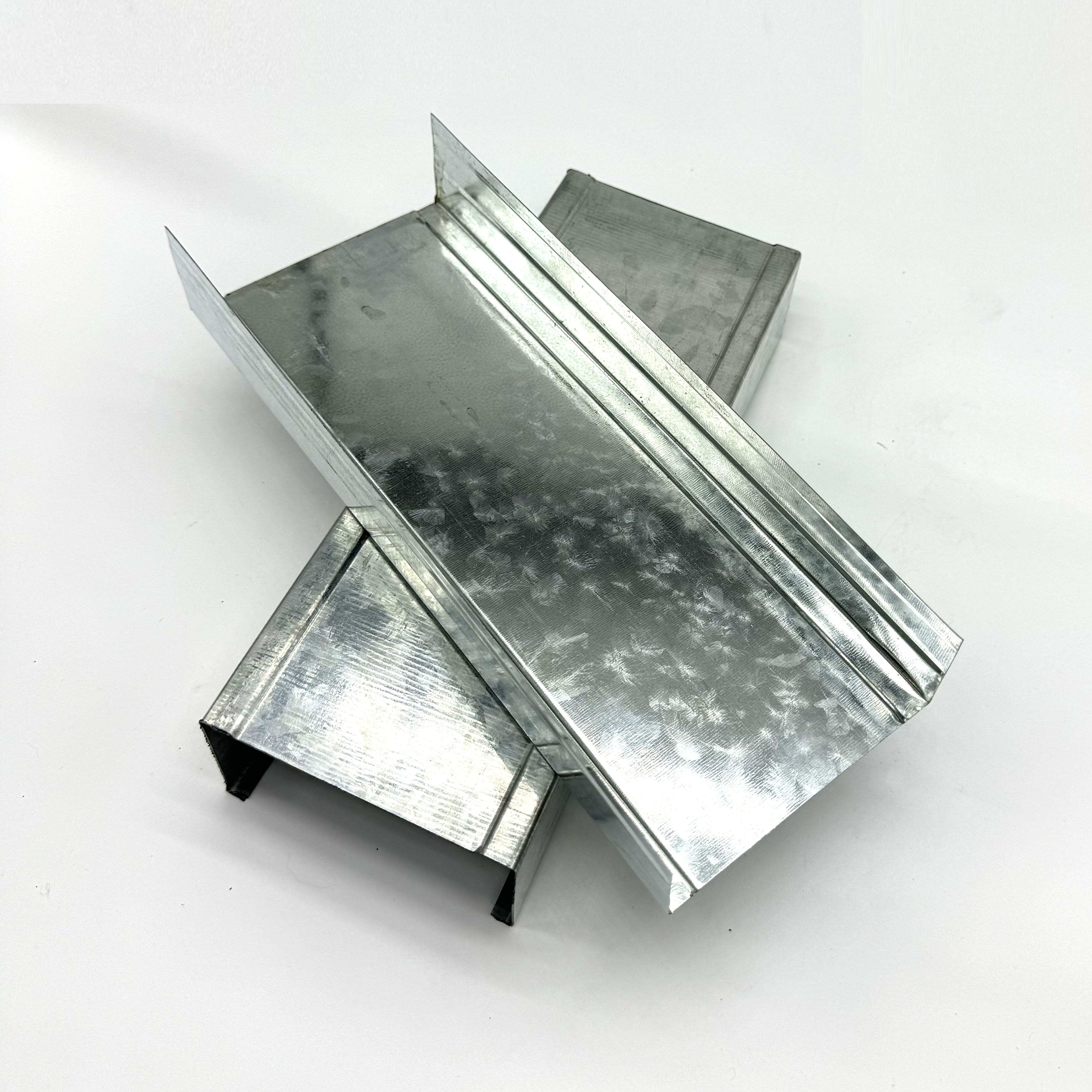


Because the stud and track work together as a system, their dimensions and thickness should be selected according to the requirements of the entire partition system.
The thickness of a steel stud is one of the factors that determines the performance of a drywall framing system.
In general, a thicker steel profile can provide:
However, thicker does not automatically mean better.
Using a significantly thicker profile than necessary can increase material consumption, transportation costs and overall project cost.
The goal is to select a thickness that provides sufficient performance for the specific application.
There is no single thickness that is suitable for every drywall project.
Common light gauge steel stud and track thicknesses may include approximately:
| Steel Thickness | Typical Application |
|---|---|
| 0.40–0.45 mm | Lightweight interior applications |
| 0.50 mm | General drywall partitions |
| 0.60 mm | Stronger partitions and commercial applications |
| 0.75 mm | Higher-performance partition systems |
| 0.80–1.00 mm+ | Heavy-duty or higher-load applications |
These ranges are only general references. Actual requirements can vary significantly depending on the local standard, steel grade, profile geometry, wall height, stud spacing and engineering requirements.
For this reason, buyers should always confirm the required specification before placing an order.
International buyers may specify drywall studs using either millimeters or gauge (GA).
For example, a customer may ask for:
One important point is that gauge is not a universal thickness measurement.
Different countries and industries may use different gauge systems, and the actual nominal thickness associated with a gauge can vary.
Therefore, when purchasing drywall studs internationally, it is better to confirm the actual required steel thickness in millimeters, together with the applicable standard or specification, rather than relying only on a gauge number.
This helps avoid misunderstandings between suppliers and buyers.
The appropriate thickness depends heavily on how the drywall system will be used.
For standard residential interior partitions, relatively light-gauge steel studs may be sufficient.
The final selection depends on:
Commercial projects may require stronger framing because of higher traffic, larger wall dimensions or more demanding performance requirements.
In these cases, a medium or heavier steel thickness may be preferred.
For tall partitions, heavy wall systems or applications with additional loads, thicker steel profiles may be required.
The engineer or project specification should determine the appropriate profile and thickness.
One of the most common mistakes when comparing drywall studs from different suppliers is looking only at the steel thickness.
Two profiles with the same nominal thickness can have different performance.
Other important factors include:
The shape and dimensions of the stud have a major effect on its stiffness.
For example, the width and height of the C-shaped profile, the flange dimensions and the design of the lips can all influence performance.
The mechanical properties of the steel also matter.
Yield strength and tensile strength can affect the performance of the finished profile.
Drywall studs and tracks are commonly manufactured from galvanized steel to provide corrosion protection.
The required coating level should be specified according to the project or applicable standard.
A wall framed at 400 mm centers may perform differently from one framed at 600 mm centers, even when the same steel profile is used.
A taller wall generally requires greater attention to stud stiffness and deflection.
Therefore, a profile suitable for a standard residential partition may not be suitable for a high commercial partition.
A practical selection process can be divided into several steps.
First identify whether the profile will be used for:
Determine the required stud and track width and profile height.
Common dimensions vary between markets and applications.
Use the project specification, engineering requirements or applicable construction standard to determine the required thickness.
Confirm the required mechanical properties and steel grade with the supplier.
For international orders, specify the required coating or applicable standard rather than leaving the requirement unclear.
Make sure the selected stud, track and other framing components are compatible.
The best result comes from designing the complete drywall framing system, rather than selecting each component independently.
Not necessarily.
A thicker stud can provide additional stiffness and strength, but it also increases material consumption and cost.
For example, if a project only requires a lightweight interior partition, using an unnecessarily heavy steel profile may not provide enough additional benefit to justify the extra cost.
On the other hand, using a profile that is too light for a tall or heavily loaded partition can result in excessive deflection or deformation.
Therefore, the correct approach is:
Choose the thickness based on the actual project requirements, not simply the thickest available option.
When requesting a quotation, international buyers should provide as much information as possible.
A useful RFQ specification can include:
Product: C Stud / U Track
Width: 50 / 70 / 75 / 90 / 100 mm
Thickness: 0.50 / 0.60 / 0.75 mm
Length: 3000 / 4000 mm or customized
Steel: Galvanized steel
Coating: According to project requirement
Quantity: Required quantity
Application: Drywall partition / ceiling
Standard: Applicable local or project standard
Providing these details allows manufacturers to quote more accurately and reduces the risk of receiving a product that does not meet the project's requirements.
For international construction projects, finding a supplier that can provide consistent specifications is just as important as choosing the correct thickness.
Pano Ceilings supplies galvanized steel studs, tracks and other light gauge steel framing profiles for drywall partition and ceiling systems.
Our products can be manufactured in different:
We work with importers, distributors, contractors and building-material companies in international markets, and can supply drywall framing products for projects in different countries.
For bulk orders, customers can provide their required drawings, specifications or sample profiles, and our team can review the requirements and provide a suitable quotation.
Looking for galvanized drywall studs and tracks for your next project? Contact Pano Ceilings with your required profile size, thickness and quantity.
Choosing the right thickness for drywall studs and tracks requires more than simply comparing millimeter measurements.
The most important factors include steel thickness, profile dimensions, steel grade, galvanized coating, stud spacing, wall height and the intended application.
For international purchasing, it is especially important to confirm the actual thickness in millimeters and the applicable standard instead of relying only on gauge numbers.
The right combination of profile geometry, steel thickness and material properties can provide the required performance while avoiding unnecessary material and cost.
If you are sourcing drywall studs, tracks or other light gauge steel framing profiles, Pano Ceilings can supply customized specifications for international projects.


